Ethical Principles of AI
Ethical principles of AI refer to the values and guidelines that help ensure Artificial Intelligence is developed and used responsibly, fairly, and safely.
The ethical principles of using AI in an academic set-up focus on ensuring that AI supports learning, research, and teaching without replacing academic honesty, human judgment, or intellectual effort.
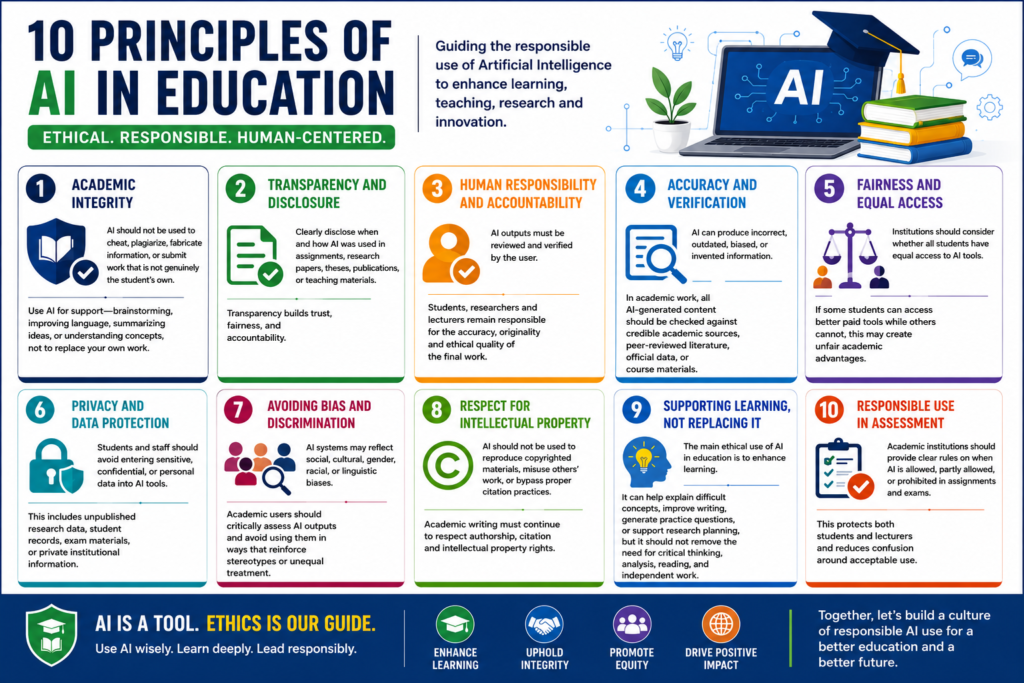
1. Academic Integrity:
AI should not be used to cheat, plagiarize, fabricate information, or submit work that is not genuinely the student’s own. Students may use AI for support, such as brainstorming, improving language, summarizing ideas, or understanding concepts, but they should not present AI-generated work as fully their own.
2. Transparency and Disclosure
Users should clearly disclose when and how AI was used, especially in assignments, research papers, theses, publications, or teaching materials. This helps maintain trust, fairness, and accountability.
3. Human Responsibility and Accountability
AI outputs must be reviewed and verified by the user. Students, researchers, and lecturers remain responsible for the accuracy, originality, and ethical quality of the final work. AI should support thinking, not replace it.
4. Accuracy and Verification
AI can produce incorrect, outdated, biased, or invented information. In academic work, all AI-generated content should be checked against credible academic sources, peer-reviewed literature, official data, or course materials.
5. Fairness and Equal Access
Institutions should consider whether all students have equal access to AI tools. If some students can access better paid tools while others cannot, this may create unfair academic advantages.
6. Privacy and Data Protection
Students and staff should avoid entering sensitive, confidential, or personal data into AI tools, including unpublished research data, student records, exam materials, or private institutional information.
7. Avoiding Bias and Discrimination
AI systems may reflect social, cultural, gender, racial, or linguistic biases. Academic users should critically assess AI outputs and avoid using them in ways that reinforce stereotypes or unequal treatment.
8. Respect for Intellectual Property
AI should not be used to reproduce copyrighted materials, misuse others’ work, or bypass proper citation practices. Academic writing must continue to respect authorship, citation, and intellectual property rights.
9. Supporting Learning, Not Replacing It
The main ethical use of AI in education is to enhance learning. It can help explain difficult concepts, improve writing, generate practice questions, or support research planning, but it should not remove the need for critical thinking, analysis, reading, and independent work.
10. Responsible Use in Assessment
Academic institutions should provide clear rules on when AI is allowed, partly allowed, or prohibited in assignments and exams. This protects both students and lecturers and reduces confusion around acceptable use.